The Story
Written in the spring of 1845 and first published posthumously by Engels in 1888 as an appendix to Ludwig Feuerbach and the End of Classical German Philosophy, the Theses on Feuerbach comprise eleven terse, aphoristic notes jotted by Marx as a private clarification of his break with both idealist and contemplative materialist philosophy. Though brief, the text marks a decisive epistemological and political shift: from viewing knowledge as a passive reflection of reality to understanding it as arising through active, sensuous human practice. The final thesis, asserting that “philosophers have only interpreted the world, in various ways; the point is to change it,” crystallizes the entire trajectory of Marx’s later work and serves as a concise rejection of the speculative detachment he associated with both Hegelian dialectics and Feuerbach’s humanism.
The core of the text critiques Feuerbach for remaining bound to an abstract conception of “man” and for failing to grasp the social and historical conditions through which consciousness is formed. For Marx, human essence is not an abstraction inherent in each individual but the ensemble of social relations, and truth must be tested not by internal coherence but through transformative praxis. Though presented without argument or elaboration, the theses are dense with implication, and their structure reveals a subterranean metaphysical struggle—one in which thought must cease to mirror being and instead enter the world as a force within it. This document, though fragmentary and never intended for publication, is among the most programmatic declarations of historical materialism, announcing a philosophy no longer content to contemplate alienation, but to abolish it.
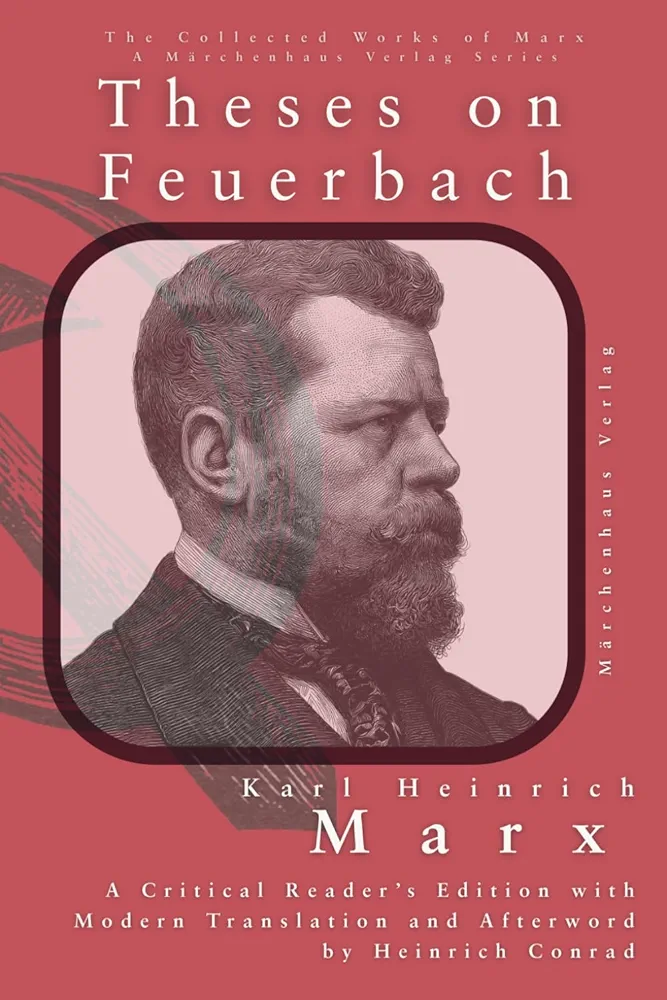
This modern Critical Reader’s Edition includes an illuminating afterword tracing Marx’s intellectual relationships with revolutionary thinkers and philosophers (including Hegel, Feuerbach, Engels, and Ricardo), containing unique research into his ideological development and economic-metaphysical theories, a comprehensive timeline of his life and works, a glossary of Marxist terminology, and a detailed index of all of Marx’s writings. This professional translation renders Marx’s dense, dialectical prose into modern language to preserve the original force and precision of the text. Combined with the scholarly amplifying material, this edition is an indispensable exploration of Marx’s classic works and his enduring Hegelian-Protestant influence in the political, religious, economic, and philosophi
cal spheres.
Description
Written in the spring of 1845 and first published posthumously by Engels in 1888 as an appendix to Ludwig Feuerbach and the End of Classical German Philosophy, the Theses on Feuerbach comprise eleven terse, aphoristic notes jotted by Marx as a private clarification of his break with both idealist and contemplative materialist philosophy. Though brief, the text marks a decisive epistemological and political shift: from viewing knowledge as a passive reflection of reality to understanding it as arising through active, sensuous human practice. The final thesis, asserting that “philosophers have only interpreted the world, in various ways; the point is to change it,” crystallizes the entire trajectory of Marx’s later work and serves as a concise rejection of the speculative detachment he associated with both Hegelian dialectics and Feuerbach’s humanism.
The core of the text critiques Feuerbach for remaining bound to an abstract conception of “man” and for failing to grasp the social and historical conditions through which consciousness is formed. For Marx, human essence is not an abstraction inherent in each individual but the ensemble of social relations, and truth must be tested not by internal coherence but through transformative praxis. Though presented without argument or elaboration, the theses are dense with implication, and their structure reveals a subterranean metaphysical struggle—one in which thought must cease to mirror being and instead enter the world as a force within it. This document, though fragmentary and never intended for publication, is among the most programmatic declarations of historical materialism, announcing a philosophy no longer content to contemplate alienation, but to abolish it.
This modern Critical Reader’s Edition includes an illuminating afterword tracing Marx’s intellectual relationships with revolutionary thinkers and philosophers (including Hegel, Feuerbach, Engels, and Ricardo), containing unique research into his ideological development and economic-metaphysical theories, a comprehensive timeline of his life and works, a glossary of Marxist terminology, and a detailed index of all of Marx’s writings. This professional translation renders Marx’s dense, dialectical prose into modern language to preserve the original force and precision of the text. Combined with the scholarly amplifying material, this edition is an indispensable exploration of Marx’s classic works and his enduring Hegelian-Protestant influence in the political, religious, economic, and philosophi
cal spheres.