The Story
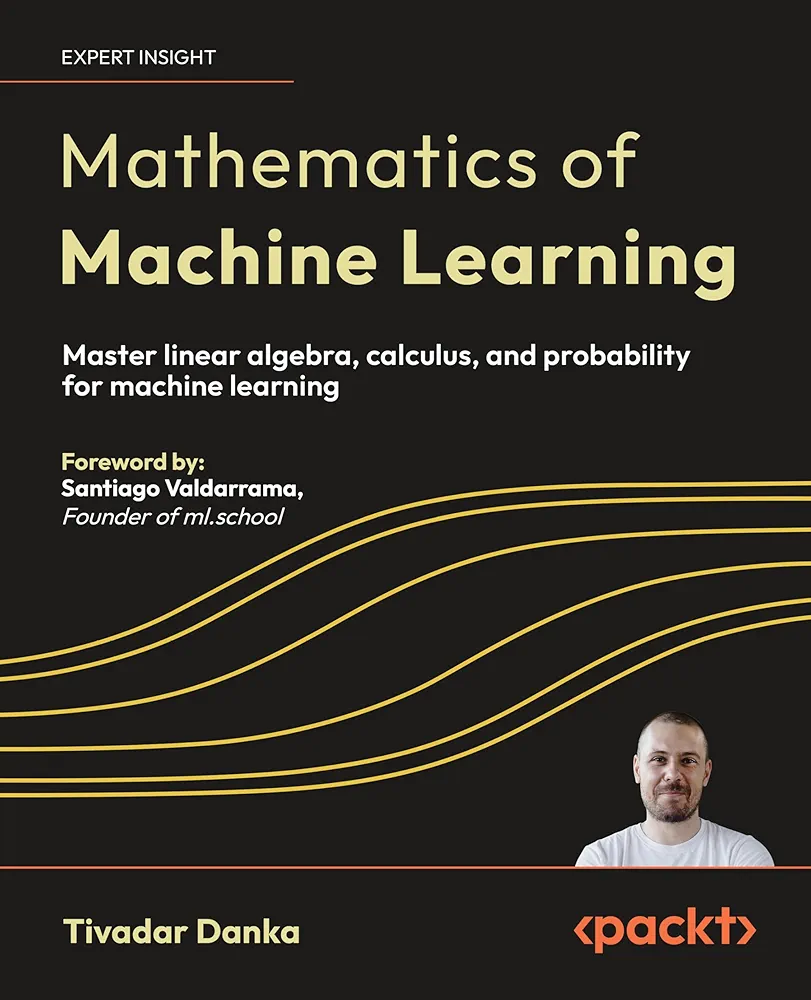
Build a solid foundation in the core math behind machine learning algorithms with this comprehensive guide to linear algebra, calculus, and probability, explained through practical Python examples
Purchase of the print or Kindle book includes a free PDF eBook
Key Features
Master linear algebra, calculus, and probability theory for ML
Bridge the gap between theory and real-world applications
Learn Python implementations of core mathematical concepts
Book Description
Mathematics of Machine Learning provides a rigorous yet accessible introduction to the mathematical underpinnings of machine learning, designed for engineers, developers, and data scientists ready to elevate their technical expertise. With this book, you’ll explore the core disciplines of linear algebra, calculus, and probability theory essential for mastering advanced machine learning concepts.
PhD mathematician turned ML engineer Tivadar Danka—known for his intuitive teaching style that has attracted 100k+ followers—guides you through complex concepts with clarity, providing the structured guidance you need to deepen your theoretical knowledge and enhance your ability to solve complex machine learning problems. Balancing theory with application, this book offers clear explanations of mathematical constructs and their direct relevance to machine learning tasks. Through practical Python examples, you’ll learn to implement and use these ideas in real-world scenarios, such as training machine learning models with gradient descent or working with vectors, matrices, and tensors.
By the end of this book, you’ll have gained the confidence to engage with advanced machine learning literature and tailor algorithms to meet specific project requirements.
What you will learn
Understand core concepts of linear algebra, including matrices, eigenvalues, and decompositions
Grasp fundamental principles of calculus, including differentiation and integration
Explore advanced topics in multivariable calculus for optimization in high dimensions
Master essential probability concepts like distributions, Bayes' theorem, and entropy
Bring mathematical ideas to life through Python-based implementations
Who this book is for
This book is for aspiring machine learning engineers, data scientists, software developers, and researchers who want to gain a deeper understanding of the mathematics that drives machine learning. A foundational understanding of algebra and Python, and basic familiarity with machine learning tools are recommended.
Table of Contents
Vectors and vector spaces
The geometric structure of vector spaces
Linear algebra in practice spaces: measuring distances
Linear transformations
Matrices and equations
Eigenvalues and eigenvectors
Matrix factorizations
Matrices and graphs
Functions
Numbers, sequences, and series
Topology, limits, and continuity
Differentiation
Optimization
Integration
Multivariable functions
Derivatives and gradients
Optimization in multiple variables
What is probability?
Random variables and distributions
The expected value
The maximum likelihood estimation
It's just logic
The structure of mathematics
Basics of set theory
Complex numbers
Description
Build a solid foundation in the core math behind machine learning algorithms with this comprehensive guide to linear algebra, calculus, and probability, explained through practical Python examples
Purchase of the print or Kindle book includes a free PDF eBook
Key Features
Master linear algebra, calculus, and probability theory for ML
Bridge the gap between theory and real-world applications
Learn Python implementations of core mathematical concepts
Book Description
Mathematics of Machine Learning provides a rigorous yet accessible introduction to the mathematical underpinnings of machine learning, designed for engineers, developers, and data scientists ready to elevate their technical expertise. With this book, you’ll explore the core disciplines of linear algebra, calculus, and probability theory essential for mastering advanced machine learning concepts.
PhD mathematician turned ML engineer Tivadar Danka—known for his intuitive teaching style that has attracted 100k+ followers—guides you through complex concepts with clarity, providing the structured guidance you need to deepen your theoretical knowledge and enhance your ability to solve complex machine learning problems. Balancing theory with application, this book offers clear explanations of mathematical constructs and their direct relevance to machine learning tasks. Through practical Python examples, you’ll learn to implement and use these ideas in real-world scenarios, such as training machine learning models with gradient descent or working with vectors, matrices, and tensors.
By the end of this book, you’ll have gained the confidence to engage with advanced machine learning literature and tailor algorithms to meet specific project requirements.
What you will learn
Understand core concepts of linear algebra, including matrices, eigenvalues, and decompositions
Grasp fundamental principles of calculus, including differentiation and integration
Explore advanced topics in multivariable calculus for optimization in high dimensions
Master essential probability concepts like distributions, Bayes' theorem, and entropy
Bring mathematical ideas to life through Python-based implementations
Who this book is for
This book is for aspiring machine learning engineers, data scientists, software developers, and researchers who want to gain a deeper understanding of the mathematics that drives machine learning. A foundational understanding of algebra and Python, and basic familiarity with machine learning tools are recommended.
Table of Contents
Vectors and vector spaces
The geometric structure of vector spaces
Linear algebra in practice spaces: measuring distances
Linear transformations
Matrices and equations
Eigenvalues and eigenvectors
Matrix factorizations
Matrices and graphs
Functions
Numbers, sequences, and series
Topology, limits, and continuity
Differentiation
Optimization
Integration
Multivariable functions
Derivatives and gradients
Optimization in multiple variables
What is probability?
Random variables and distributions
The expected value
The maximum likelihood estimation
It's just logic
The structure of mathematics
Basics of set theory
Complex numbers